Vibrant
Streets
Manchester City Council, in partnership with Keep Manchester Tidy and Manchester City Co, was grappling with one of its most persistent urban problem: litter.
Location: United Kingdom
01 | CHALLENGE
The Challenge
No Litter, No Budget, Big Challenge
Keep Manchester Tidy is an innovative partnership between Manchester City Co and environmental charity Keep Britain Tidy. The partnership aims to develop interventions that address all forms of littering across the city. The challenge was big: drive zero littering in the city of Manchester through a solution with no budget whatsoever.
Our Approach
From our research we realized that littering was a multi-factor issue with many possible approaches so we focused on the item that was most littered: cigarettes.
Following the UK-wide indoor smoking ban, smokers increasingly moved outdoors— often smoking in front of shops, cafés and office buildings. However, these areas rarely provided convenient or visible ways to dispose of cigarette butts.
This created a cycle in which:
-
Smokers struggled to find appropriate disposal points
-
Businesses had to clean the areas in front of their storefronts
-
Cigarette filters accumulated in streets and public spaces
-
Plastic, nicotine, heavy metals and other chemicals entered the environment
The challenge was not only to create a new ashtray, but to design an intervention capable of influencing behavior and creating shared ownership of public spaces.
My Role
I was the leader of the group and also acted as PMO (Project Manager), UX Researcher and Service Designer
And the main question remained:
How might we enable smokers to dispose of their cigarettes properly while encouraging a sense of pride and ownership of the streets they use?
02 | METHOD
Research
To understand the problem space, we combined secondary research, business interviews and observational research across different areas of Manchester
Secondary Research
The research focused on the environmental impact of cigarette litter and the behavioral factors that influence disposal habits.
Behavioral Patterns
Research into pro-environmental behavior highlighted two important psychological drivers:
Pride
Positive messaging that creates a sense of accomplishment can be more effective than messaging based on guilt or fear.
Ownership
A stronger sense of ownership toward a place can encourage people to take responsibility for maintaining it. These findings led us to explore how cigarette disposal could become a visible, positive and socially meaningful action.
Understanding the size of the problem
4.5 Tri
Cigarettes littered each year worldwide.
68%
Smoking related litter, according to Keep Britain Tidy research.
977,000
Cigarettes smoked daily in Manchester, where 65% of them are litter, resulting in 145kg of wate daily accordingly to Smoke-free Manchester.
£40 mi
Yearly cost of littered cigarette butts cleaning across the United Kingdom

Context Mapping
The 2007 indoor smoking ban fundamentally changed the behavior and movement patterns of smokers in the UK.
Smoking became an outdoor activity, often concentrated around storefronts and office entrances. However, the infrastructure surrounding these new smoking areas did not evolve with the behavior.
This created a gap between:
-
Where people smoke
-
Where disposal facilities are located
-
Who is responsible for keeping the area clean
Primary Research
Business Interviews
We spoke with local managers and business owners to understand how cigarette litter affected their daily operations.
Their experiences revealed that:
-
Storefronts were difficult to keep clean
-
Employees regularly cleaned public areas in front of their businesses
-
Businesses invested time and money in removing cigarette butts
-
Cigarette butts made up the majority of litter found outside many stores
Etnographic Behavioral Research
We observed smokers in different areas of the city to understand their habits, choices and disposal behaviors.
The main findings were:
-
People frequently take smoking breaks on sidewalks, outside shops, cafés and offices
-
Most of these locations do not have ashtrays or designated cigarette disposal points
-
Smokers often dispose of cigarette butts by throwing them into the street
-
Public bins are difficult to find and are often located far from smoking areas
-
Since smokers have been pushed outdoors, the lack of convenient disposal solutions makes littering easier
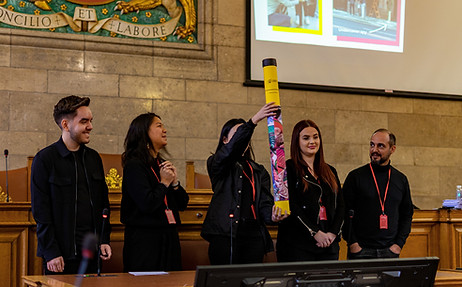
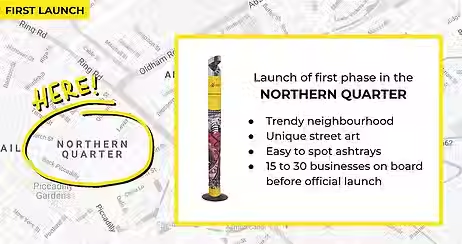

Placing a positive-behavioral solution where the gap is
We designed a dedicated cigarette disposal point positioned along business storefronts— the places smokers already frequent.
-
The solution created value for multiple stakeholders:
-
Smokers gained a convenient way to dispose of cigarette butts
-
Businesses could maintain cleaner storefronts with less effort
-
The city could reduce cigarette litter in high-impact public areas
-
The environment benefited from fewer filters entering streets, drains and waterways
Partnering with local businesses also helped distribute responsibility across the city, transforming cigarette disposal from an individual action into a shared service.
Behavioral Design
The intervention encouraged smokers to develop a sense of pride in and ownership of the area as a comfortable and welcoming place.
Rather than using shame-based messaging, the concept focused on creating a positive commitment:
This is our street. Let’s keep it clean.
The goal was to make responsible disposal feel simple, visible and socially expected.
Prototyping & Iteration
We used data from the research phase and feedback from client meetings to formulate our behavioral hypothesis and develop the prototype.
-
The concept was iterated based on:
-
The location and visibility of the disposal point
-
The relationship between businesses and smokers
-
The clarity of the desired behavior
-
The practicality of maintaining the solution
-
The potential for the intervention to scale across the city
Results
03 | OUTCOME
Impact
Winning Project (1st Place)
The concept was selected as the winning proposal for Manchester City Council and was chosen to move forward toward implementation.
The proposed service had the potential to:
-
Reduce cigarette litter in highdensity smoking areas Decrease the time and cost businesses spend cleaning storefronts
-
Prevent cigarette filters from entering storm drains and waterways
-
Encourage more positive and sustainable disposal behaviors
-
Support Manchester’s ambition to become the UK’s first “Tidy City”
The project was selected to be implemented by the Manchester City Council and Keep Manchester Tidy